
Booked
in 2026
trend report



The UK beauty market has entered 2026
with a decisive, resilience-driven mindset.
Beauty and barbering professionals show strong alignment around the realities of rising costs, the necessity of price increases, and the importance of visibility through social media.
The UK stands out as the most commercially disciplined market in the 2026 data set. UK professionals are prepared to act — raising prices, refining offerings, and leaning into education, authenticity, and consistency to stay competitive.
Consumer Spending
Death of the Dupe: Why UK Clients are Saving on Home-Kits to Splurge on the 'Un-Dupeable' Salon Expert
The UK beauty and barbering market is defined by a powerful paradox: The "Cost-of-Living Crunch" vs. The "Wellness Essential." While inflation and tax changes (like the April 2026 National Living Wage increase to £12.71) are squeezing salon margins, British consumers have officially reclassified professional beauty as an "essential" rather than a luxury.



The "Essential-isation" of Beauty
A massive shift in mindset has occurred. According to recent Barclays data, 46% of UK consumers now categorise health and beauty products and services as "essentials"—placing them in the same budgetary bucket as groceries and childcare.
Spending Growth:
The total UK beauty market is projected to reach £59.28 billion in 2026.
Projected Growth:
Despite economic pressures, consumer spending in health and beauty has shown resilience, with a 7.3% year-on-year increase in the lead-up to 2026.
Market Value:
The UK salon services market alone is projected to reach $18.46 billion (£14.6 billion) by the end of 2026.

Luxury vs. "Dupes": The Split Spending Habit
UK consumers are currently practicing "Bipolar Spending"—they are happy to save on products to "splurge" on professional experiences.
The "Dupe" Economy:
32% of consumers are actively buying "dupes" (affordable product alternatives) to save money.
The Experience Splurge:
However, that saved money is being funneled back into the salon chair. Consumers are seeking "Experiential Beauty"—services that cannot be replicated at home, such as advanced hair colouring (which now dominates 32% of the hair market) and professional-grade scalp treatments.
"Treatment Tourism":
43% of consumers no longer view "tweakments" (minor aesthetic procedures) as taboo, leading to a rise in clinical-grade services being integrated into traditional salons.

Sector Breakdown: Hair, Nails, and Barbering
The "High-Value" Consultation
The Spending Shift: British clients are moving away from bulk buying and toward high-value, performance-led treatments.
Key Growth: Demand for professional hair care is growing at a 5.3% Compound Annual Growth Rate (CAGR) in England, particularly for services that offer "visible results" like repair, colour longevity, and scalp balance.
Trend: Clients are willing to pay a premium for "Scientific Haircare"—they want the stylist to act as a consultant who explains the molecular health of their hair.
The "Aesthetic Staple"
The Boom: The nail salon subsector is currently the fastest-growing niche in the UK beauty industry.
Spending Habit: Nails have become the "low-cost luxury" that consumers refuse to give up. Even when cutting back on larger purchases, the £30–£60 monthly manicure remains a non-negotiable part of the UK beauty budget.
Personalisation: 82% of UK adults are actively seeking personalised beauty solutions, leading to higher spending on custom-sculpted nail art.
The "Community Hub" Spend
The Landscape: There are now approximately 19,000 barbershops in the UK.
Spending Shift: Men’s grooming has evolved into a "Social Salon" experience. The "Men's Segment" is growing rapidly as awareness of grooming and hygiene increases.
The Upsell: Barbers are seeing success by adding "ritual" services (facial steaming, beard shaping, and scalp detoxes) which are driving up the average transaction value.
The "Wellness" Premium
In 2026, you cannot talk about beauty spending in the UK without talking about wellness.
The Stat:
40% of consumers view wellness as an essential part of their beauty regime.
The Opportunity:
57% of UK consumers report they are willing to pay more for products and services that offer climate/pollution defense or "holistic" benefits.

Booksy recently conducted a global survey of UK beauty professionals, The UK shows the clearest pricing alignment amongst all of the market surveys:
Why this matters:
Unlike the US or Spain — where hesitation and uncertainty persist — the UK has already mentally crossed the pricing threshold.
100% of UK providers plan to raise prices in 2026
100% expect price increases in the 10–15% range
100% review pricing on a regular 1–2 year cadence
What does this mean for Beauty Pros?
For beauty and barbering professionals in the UK, the data sends a clear message: The middle ground is disappearing. Consumers are saving money on products at home specifically so they can afford a high-end, expert experience in your chair.
Here is the strategic takeaway for your business:
Pivot from "Maintenance" to "Transformation"
Since clients are using "dupes" and home kits for basic maintenance, your service menu must offer what they cannot do themselves.
The Move: Double down on technical services like complex colour corrections, advanced scalp therapy, and chemical hair repair.
The Takeaway: If a client can do it in their bathroom, don't make it your "hero" service. Focus on the "Scientific Consultation" where you prove your expertise.


Implement the "Essential Luxury" Pricing Model
UK consumers have reclassified beauty as an "essential." They will pay for it, but they are hyper-aware of value.
The Move: Don't just raise prices; increase the "Perceived Value." Add a complimentary 5-minute scalp massage, a personalised aftercare digital guide, or a premium beverage.
The Takeaway: Clients aren't looking for the cheapest price—they are looking for the best return on investment for their well-being.
Lean Into the "Wellness" Upsell
With 40% of UK consumers seeing beauty as a wellness pillar, your salon should be an "Emotional Reset" zone.
The Move: Introduce "Low-Touch" wellness add-ons like aromatherapy during a wash or under-eye collagen masks during a barbering shave.
The Takeaway: These small additions turn a standard appointment into a "wellness ritual," justifying premium rates and ensuring client loyalty during economic shifts.


Capturing the "Social Searcher"
Since UK clients are savvy researchers using AI and TikTok to find value, your digital presence must be "evidence-based."
The Move: Stop posting just "pretty hair." Start posting "Problem & Solution" content (e.g., "How I saved this client's porous hair using [Treatment]").
The Takeaway: Use keywords like "Healthy Hair," "Scalp Health," and "Personalised Styling" to ensure you appear in 2026 AI-driven search results.
The Bottom line
The 2026 UK consumer is selective but willing. They are cutting back on "stuff" to spend more on self-care and expertise. As long as you position yourself as a specialised "Health & Wellness Consultant" rather than just a "Service Provider," your booking diary will remain full.
UK consumers have officially reclassified professional beauty as an "essential" rather than a luxury, with 46% of consumers placing beauty services in the same budgetary bucket as groceries. The total market is projected to reach £59.28 billion by the end of 2026.
While 32% of consumers buy "dupes" to save on products at home, they funnel those savings back into the salon chair for "un-dupeable" professional experiences like advanced hair colouring and clinical-grade scalp treatments.
Wellness is now an essential part of the beauty regime for 40% of consumers. Furthermore, 57% of UK clients are willing to pay more for services that offer holistic benefits, climate defense, or an "emotional reset".



UK Beauty Industry Market Structure
Beyond the Chair: Why 61% of UK Stylists are Ditching the Salon Floor to Become the New 'Micro-Entrepreneurs' of 2026
The shift toward micro-entrepreneurship in the UK has moved from a "market trend" to the dominant market structure. In 2026, the landscape is defined by a massive pivot toward self-employment, driven by the "perfect storm" of rising business rates, high energy costs, and the £12.71 National Living Wage.
The Dominance of Micro-Entrepreneurs
The "Solo Economy" is officially the new standard. Traditional employment models are under immense pressure as professionals realise they can earn more with lower overhead by operating independently.
Self-Employment Share:
As of early 2026, 61% of the hair and beauty workforce is self-employed, up from 58% in 2024 and just 46% in 2006.
The "Micro" Majority:
95% of all beauty businesses in the UK now employ fewer than 10 people. The industry is effectively a massive network of tiny, independent nodes.
The £90k "Glass Ceiling":
A significant quantitative trend is the VAT bunching effect. Many micro-entrepreneurs purposely cap their bookings or days worked to stay just below the £90,000 VAT threshold, as crossing it triggers a 20% tax hit that often negates the profit of expansion.
The Decline of Traditional High Street Salons
While independent pros are booming, premises-based salons are facing what industry bodies call a "devastating" cumulative burden.
Salon Closures:
Traditional hair salons in Great Britain have been closing at a net rate of roughly 300–400 per year leading into 2026.
Apprenticeship Crisis:
This structural shift has caused a 70% drop in hairdressing apprenticeship enrolments since 2015. Because self-employed pros rarely train juniors, the industry is facing an acute "Senior Stylist" shortage in 2026.
Business Rates Inequality:
A major point of friction in 2026 is the 15% business rates relief granted to pubs and music venues, which has not been extended to salons, further accelerating the move toward mobile or home-based work.

Sector-Specific Growth Trends
Despite the overhead challenges, specific sub-sectors are showing high "unit growth" on the high street, primarily through micro-business models.
Growth Metric (2026 Projection)
+660+ net new units
Why it's Trending
The fastest-growing high-street category; driven by low-overhead, "walk-in" micro-shops.
Growth Metric (2026 Projection)
+300+ net new units
Why it's Trending
High frequency of visit and low equipment costs make this the most resilient "entry-level" business.
Growth Metric (2026 Projection)
£2.3 Billion Market
Why it's Trending
Hair colour alone accounts for 32% of salon revenue, as consumers prioritise "un-dupeable" services.
Emerging 2026 Market Dynamics
The "Home-Tech" Bridge: A "Two-Fold Opportunity" has emerged. While 75% of consumers prioritise self-care, they are spending 59% more on at-home beauty devices.
The Takeaway:
Successful UK pros in 2026 are positioning themselves as "Tech-Consultants," teaching clients how to use these devices to extend the results of their professional salon treatments.
The "Digital Concierge" Model:
Platforms like Ruuby are seeing a shift where customers book less frequently but spend significantly more per visit (averaging a 15-20% increase in order value).
VAT-Driven Hybridisation:
To survive, traditional salons are increasingly adopting "Chair Rental" exclusively. They are becoming "Beauty Co-working Spaces" rather than employers, which allows them to bypass the National Insurance and VAT complications of a large staff.

Driven by rising business rates and the £12.71 National Living Wage, 61% of the hair and beauty workforce is now self-employed. The industry is largely composed of "micro-nodes," with 95% of businesses employing fewer than 10 people.
Many micro-entrepreneurs purposely cap their bookings to stay below the £90,000 VAT threshold. Crossing this limit triggers a 20% tax hit that often negates the financial benefits of expanding the business.
Traditional high-street salons are increasingly adopting "Chair Rental" models, effectively becoming "Beauty Co-working Spaces". This allows them to manage the overhead of premises while bypassing the National Insurance complications of large staffs.
Taxation - What Beauty Pros Need to Know this Tax Season
The End of the Shoebox of Receipts: Why April 2026 Marks the Biggest Digital Tax Shake-up for UK Beauty Pros in 30 Years
The UK tax landscape for beauty and barbering professionals is undergoing its most significant overhaul in nearly 30 years. While 2026 brings some "cost crunches," it also offers new credits that many pros are unaware of.
Here is the breakdown of the 2026 UK tax trends and laws beauty and barbering pros must include in your report.


The Digital Revolution: MTD ITSA (April 6, 2026)
The Digital Revolution: MTD ITSA (April 6, 2026)
The Digital Revolution: MTD ITSA (April 6, 2026)
This is the single largest change for self-employed pros since 1997.
The Law: Making Tax Digital for Income Tax (MTD ITSA) officially begins.
The Threshold: If your gross annual turnover is over £50,000, you must stop using paper ledgers or simple spreadsheets.
The Impact: You are now required to submit quarterly digital updates (every 3 months) to HMRC using approved software. You no longer wait until January 31st to "see" your tax bill; you must track it in real-time.
What Pros Don't Know: This threshold is set to drop to £30,000 in April 2027, so even if you aren't at £50k yet, you need to digitise your records now to avoid penalties later.

The "Hidden" Dividend Tax Hike
The "Hidden" Dividend Tax Hike
The "Hidden" Dividend Tax Hike
Many salon owners pay themselves via a mix of salary and dividends to be tax-efficient.
The Trend: From April 2026, the dividend tax rate is increasing by 2%. The basic rate will jump from 8.75% to 10.75%.
The Impact: If you operate as a Limited Company, your "take-home" pay will decrease unless you adjust your draw. Salon owners should consult their accountants to see if shifting to a higher PAYE salary is now more beneficial than the traditional dividend model.

Business Rates Relief for Retail & Salons
Business Rates Relief for Retail & Salons
Business Rates Relief for Retail & Salons
Finally, some good news for those with a physical high-street presence.
The Law: A new lower permanent tax rate for retail, hospitality, and leisure properties has been introduced for the 2026-27 tax year.
The Impact: Most salons will see a reduction in their business rates bill. Properties with a rateable value under £500,000 will pay 5p less than the standard multiplier.

The VAT "Standard-Rating" Crackdown
The VAT "Standard-Rating" Crackdown
The VAT "Standard-Rating" Crackdown
HMRC is tightening its grip on what qualifies as a "medical" versus "aesthetic" treatment.
The Trend: Following recent tribunal rulings, many advanced aesthetic treatments (filler, Botox, certain chemical peels) are being strictly classified as standard-rated (20% VAT) unless performed by a medical professional for a therapeutic purpose.
The Impact: Beauty pros who were previously exempting these services from VAT must now either register for VAT or absorb a 20% margin hit.

From 6 April 2026, Making Tax Digital (MTD ITSA) requires self-employed pros with a turnover above £50,000 to submit quarterly digital updates to HMRC. This marks the end of paper ledgers and "shoeboxes of receipts".
The dividend tax rate is increasing by 2% in April 2026, with the basic rate jumping to 10.75%. This shift may lead many salon owners to move away from dividend-heavy pay structures toward higher PAYE salaries.
Yes, a new lower permanent tax rate for retail and beauty properties with a rateable value under £500,000 has been introduced for the 2026-27 tax year, offering much-needed relief for high-street locations.

Technology Adoption: Impact of AI on the Beauty Industry
From Intuition to Intelligence: How the 'Invisible AI Assistant' is Saving 1,500 Hours a Month for UK Beauty Pros in 2026
The UK beauty and barbering industry has officially entered the "Utility Era" of Artificial Intelligence. For British pros, AI has moved from a futuristic "nice-to-have" to a foundational tool for operational survival, especially in the face of rising 2026 overhead costs.
Booksy’s Trend Report survey revealed the UK beauty and barbering pros view AI Readiness as Cautious but Functional.
feel somewhat comfortable with AI
are curious but unsure
report being fully uncomfortable

The Quantitative Reality: Adoption & Economic Impact
AI is no longer exclusive to global giants like L'Oréal; it has democratised high-tech tools for independent UK micro-pros.
Qualitative Impact: The "Invisible Assistant"
In the UK, the qualitative value of AI isn't about robots cutting hair—it’s about removing the "Administrative Weight" from the professional’s shoulders.

Top 3 AI Trends for UK Beauty & Barber Pros to Watch in 2026
What to know: Conversational AI assistants (like advanced versions of Booksy's voice tools) now handle after-hours calls, answer FAQs about service ingredients, and book appointments in brand-specific tones.
Business Growth: Salons using 24/7 AI receptionists see a 20-30% increase in after-hours bookings.
What to know: If the AI knows a client’s highlights typically fade after 6 weeks, it automatically sends a personalised "Tone & Gloss" invite at week 5.
Business Growth: This "Invisible Marketing" boosts rebooking rates by 15% without the pro ever lifting a finger.
What to know: Tools for 3D Scalp Analysis and AI Skin Mapping are becoming standard. These tools distinguish between types of conditions (like vascular vs. epidermal pigmentation) that the human eye might miss.
Business Growth: Professionals using AI diagnostics report higher retail sales (up to 40% increase) because clients trust the data-backed product recommendations.

"People bring in AI photos for nails, I love the inspiration. We are looking at an AI nail lamp that detects where a client's fingers are. It detects where the nails are and only emits light to your nails. This is the future!"
Organisations that fully operationalise AI are saving an average of 1,500+ internal hours monthly. AI handles the "logic" of bookings and stock, allowing the professional to focus 100% on the client.
Since 71% of UK salon regulars have abandoned a booking because it was too hard to reach the pro, AI receptionists that handle after-hours calls can increase bookings by 20-30%.
Using AI for 3D Scalp Analysis and Skin Mapping provides evidence-based data that clients trust. Professionals using these tools report up to a 40% increase in retail sales due to data-backed product recommendations.
Top UK Beauty & Barbering Craft Trends
"The 'British Bob' & The 'Chillet': Why UK Salons are Ditching High-Maintenance Glam for 'Lived-In Luxury' in 2026
HAIRSTYLISTS
In 2026, the UK hair scene is moving away from high-maintenance perfection toward "Quiet Luxury" shapes and "Lived-in" technicality. For licensed pros, this is an opportunity to shift from "quick cuts" to "bespoke sculpting," allowing for higher service premiums.
Here are the top 3 projected hairstyling trends for the UK in 2026:

While the bob is a perennial favourite, the 2026 UK version—dubbed the "British Bob"—is all about diffused edges and weightless structure. Unlike the sharp Italian or French bobs of previous years, this style focuses on a clean outline paired with natural, airy texture that air-dries into a chic shape.
Why it’s trending: It answers the consumer demand for "low-maintenance luxury." It looks expensive but requires minimal daily heat styling.
Pro Opportunity: Position this as a "Precision Sculpt" on your menu. Because it requires advanced layering to ensure a "soft" grow-out, you can price it 15-20% higher than a standard trim.

The extreme "Wolf Cuts" and "Mullets" of 2024 have evolved into the "Chillet" (Chic-Mullet). It features shorter, face-framing strands with relaxed, fashion-forward lengths in the back, but with a softer, more "feminine" or wearable finish than its punk-rock ancestors.
Why it’s trending: It’s the "Gemini Cut" of 2026—offering dual-length flexibility for clients who want an edgy look that still feels professional for the office.
Pro Opportunity: This is a high-skill cut that involves "Hidden Structures." Market it as a "Transformation Cut" and bundle it with a Scalp Detox or Bond-Builder treatment to maximise the service value.

Traditional balayage has matured into "Colour Melting." The goal is a seamless, tonal transition that mimics how hair looks in natural light. In terms of palette, "Cinnamon Blonde" (a tawny, beige-gold) and "Espresso Brunette" (hyper-glossy, deep brown) are the top requests.
Why it’s trending: With the UK's 2026 focus on "Hair Health," clients are avoiding harsh bleaches in favor of "low-chemical" melting techniques that offer a 4-5 month grow-out.
Pro Opportunity: Move away from "Full Head Highlights" and introduce "Dimensional Melting" packages. Since these require less frequent visits, you can justify a higher "Luxury Tier" price point for the initial session.
Impact on UK Hairstylist Service Menus & Pricing
The shift in 2026 is moving from "Time-Based Pricing" to "Value-Based Packaging."
2026 Trend Upgrade
The Sculpted British Bob
Pricing Strategy
Increase by £10-£15 (Expertise Premium).
2026 Trend Upgrade
Lived-in Tonal Melt
Pricing Strategy
Increase by £10-£15 (Expertise Premium).
2026 Trend Upgrade
The "Midi Blowout" with Scalp Ritual
Pricing Strategy
Increase by £10-£15 (Expertise Premium).
takeaway for pros
2026 is the year of "Math-Based Pricing." With the UK National Living Wage at £12.71, your menu should prioritise high-margin "Add-ons" like bond repairs and glosses which take 5 minutes but increase the ticket price by 20%.
NAIL TECHS
The UK nail market is shifting away from the "disposable" fast-fashion approach to a focus on High-Performance Naturality and Futuristic Textures. For nail techs, this means moving away from basic colour applications toward complex "hybrid" services that command higher hourly rates.
Here are the top 3 nail trends for 2026 that every UK nail tech should be aware of:

Inspired by the Pantone 2026 Colour of the Year, Cloud Dancer (a soft, airy off-white), this trend prioritises the "Clean Girl" aesthetic but with a technical upgrade. It’s not just about a sheer colour; it's about Builder Gel (BIAB) or Structured Manicures that mimic a natural nail while providing indestructible strength.
Why it’s trending: UK consumers are viewing nails as "skin-adjacent" health. They want the strength of acrylic without the perceived damage.
Impact on Menu: Replace "Standard Gel Polish" with "Signature Structured Mani" or "BIAB Strength Layer."
Pricing Strategy: These services take 15–20 minutes longer but allow you to charge a £10–£15 premium over a basic gel service.
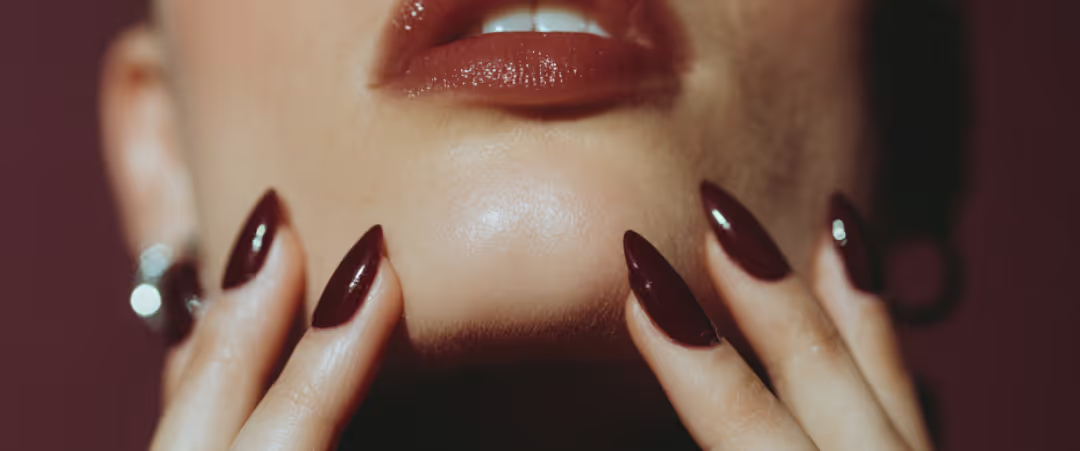
The "Cat Eye" of the past has evolved into the "Chrome-Velvet Hybrid." This look combines the depth of magnetic velvet powders with the sharp reflection of metallic chrome accents (often used as "Isolated Chrome" lines or "Liquid Metal" drips on top of a matte velvet base).
Why it’s trending: It’s the "Jewelry Nail" of 2026. It feeds into the "Little Treat" culture where clients want a high-impact, tactile look that looks like fine art.
Impact on Menu: Introduce "Multi-Dimensional Art" tiers.
Pricing Strategy: This is a high-skill add-on. Charge per nail (e.g., £3–£5 per accent nail) or as a full "Luxury Art" set with a 25% markup on your base price.

K-Beauty influences have matured in the UK into "Jelly Gradients"—translucent, glass-like washes of colour—finished with an ultra-thin "Micro-French" tip in a contrasting neon or metallic.
Why it’s trending: It’s the ultimate "Quiet Luxury" look for the office. It grows out beautifully, which appeals to the UK consumer's desire for "Low-Maintenance Longevity."
Impact on Menu: Add a "French 2.0" or "Micro-Detailing" option.
Pricing Strategy: While the "Micro-French" line is thin, it requires extreme precision. Market it as "Detail Work" and add a fixed £5–£8 fee to the service total.
2026 UK Pricing Guide for Nail Techs
With the National Living Wage increasing to £12.71 in April 2026, UK techs must move away from "flat-rate" pricing to protect their margins.
2026 Trend replacement
Structured BIAB / Cloud Dancer Sheer
Recommended Price Shift
+£10 (Focus on nail health)
2026 Trend replacement
Chrome-Velvet Hybrid (Mixed Media)
Recommended Price Shift
+£10 (Focus on nail health)
2026 Trend replacement
Micro-French / Jelly Gradient
Recommended Price Shift
+£5 (Focus on precision)
BARBERS
The UK barbering market is moving away from the "Carbon Copy" skin fades of the early 2020s toward "Refined Masculinity." The shift is focused on hair health, natural movement, and tailoring cuts to the individual's lifestyle, which allows barbers to move from "volume-based" pricing to "Expert-Led" service tiers.
Here are the top 3 barbering trends for 2026 in the UK:

The harsh, high-contrast skin fades are being replaced by the "Soft Taper." This version of the French Crop features a longer, "choppier" top with weightless texture and a low-tapered neckline and ears rather than a scalp-level shave.
Why it’s trending: It’s the "Executive's Choice." It grows out cleanly over 4 weeks, making it popular for UK professionals who want a sharp look that doesn't look "overdone" in a meeting.
Impact on Menu: Rebrand your standard fade as a "Signature Taper & Sculpt."
Pricing Strategy: Because this requires more scissor-over-comb work and strategic weight removal than a clipper-heavy fade, you can charge a £5–£8 premium for the increased technical time.

The "Cat Eye" of the past has evolved into the "Chrome-Velvet Hybrid." This look combines the depth of magnetic velvet powders with the sharp reflection of metallic chrome accents (often used as "Isolated Chrome" lines or "Liquid Metal" drips on top of a matte velvet base).
Why it’s trending: It’s the "Jewelry Nail" of 2026. It feeds into the "Little Treat" culture where clients want a high-impact, tactile look that looks like fine art.
Impact on Menu: Introduce "Multi-Dimensional Art" tiers.
Pricing Strategy: This is a high-skill add-on. Charge per nail (e.g., £3–£5 per accent nail) or as a full "Luxury Art" set with a 25% markup on your base price.

For the low-maintenance client, the 2026 buzz cut is all about "Grooming Precision." It’s a uniform short length paired with razor-sharp "Line-Ups" around the forehead and a "Faded Beard" that connects seamlessly.
Why it’s trending: It highlights facial features and requires zero daily styling. It’s a powerful, minimalist look that is gaining massive traction among UK gym-goers and busy entrepreneurs.
Impact on Menu: Introduce the "Power Buzz & Beard Ritual."
Pricing Strategy: While the cut is fast, the beard fade and razor line-up are premium skills. Bundle them into a 30-minute high-value package that costs more than a standalone haircut but less than a full restyle.
2026 UK Barbering Pricing Strategy
With the National Living Wage rising to £12.71 and high business rates, UK barbers can no longer survive on £15–£20 "fast fades."
2026 Trend replacement
Textured Taper & Sculpt
Pricing Strategy
+£5 (Expertise Fee)
2026 Trend replacement
The Elevated Buzz & Beard Ritual
Recommended Price Shift
+£10 (Bundle Value)
2026 Trend replacement
The "Chillet" Restyle
Pricing Strategy
+£15 (Technical Transformation)
The "Subscription" Model for Barbers
In 2026, "Frequency is King." Many top UK shops are introducing "Unlimited Taper Clean-ups" for a monthly subscription fee. This ensures the client always looks sharp (boosting your shop's "walking advertisement" value) while providing you with guaranteed recurring revenue to cover rising overhead.

"The trend for 2026 for barbers is networking. We are not one dimensional, we are multi-dimensional. We do content, work with brands, go to events. Going to events can help you network and meet new people who can inspire you."
The "British Bob" (weightless structure), the "Chillet" (soft-mullet evolution), and Lived-in "Colour Melting" are the dominant requests, all focusing on "Quiet Luxury" and low-maintenance hair health.
"Cloud Dancer" minimalism (using BIAB for natural strength), Chrome-Velvet fusions, and "Micro-French" tips are the top trends, reflecting a shift toward high-performance naturality.
Barbering is shifting toward "Refined Masculinity," with the "Soft Taper" and "Baby Mullet" replacing harsh skin fades. There is also a significant rise in "Elevated Buzz Cuts" paired with razor-sharp beard rituals.


social media
The New Yellow Pages: Why TikTok and Instagram have Officially Become the UK’s Primary Search Engines for Beauty Discovery in 2026
The UK’s social media landscape has shifted from "Performative Perfection" to "Evidence-Based Authenticity." For barbers, nail techs, and hairstylists, the goal is no longer just to look "cool" on the feed, but to provide a digital paper trail of expertise that converts a scrolling observer into a booked client.
Here are the top 5 social media trends for UK beauty pros in 2026.
The "Founder-Led" Trust Surge
The UK market is moving away from faceless salon brands. Data shows that 43% of UK consumers trust a beauty business more when the founder is active and "humanised" on social media.The
Trend:
Micro-Vlogging the Business. This isn't just showing a haircut; it’s a "Day in the Life" of a shop owner—discussing the new £12.71 Living Wage, the struggle of choosing new HEMA-free gel colours, or the morning shop-opening ritual.
Quantitative Win:
Founder-led posts in the UK are currently seeing 3x higher engagement rates than standard promotional graphics.
Stop being a "Business Account" and start being a "Professional Person." Share your values, your coffee order, and your "why."
"Scientific Storytelling" (Macro-Realism)
With 64% of UK adults now using AI search tools to guide beauty purchases, the "Pretty Picture" is no longer enough. AI and consumers alike are looking for evidence of skill.
The Trend:
High-Definition Macro Content. For nail techs, this means 4K close-ups of pristine cuticle work. For barbers, it’s the "texture-shot" showing the precise gradient of a skin fade.
The "Cool" Factor:
Use ASMR (Autonomous Sensory Meridian Response) audio—the sound of the clippers, the "clink" of the polish bottle, or the "shush" of a spray bottle.
Invest in a macro lens for your phone. Use caption keywords like "Pore-level precision" or "Cuticle health focused" to appease both human eyes and AI search algorithms.
"Little Treat" Culture & Joyful Branding
In a 2026 economy where "big luxuries" (like houses or new cars) feel distant for many, the "Little Treat" has become a vital consumer coping mechanism.
The Trend:
Emotional Reward Branding. Mentions of "little treats" in the UK have climbed to over 40,000 per month. Beauty pros are branding their services as an "Escape" or a "Moment of Positivity" rather than just a grooming task.
Quantitative Win:
23% of UK marketers say that promoting small, feel-good purchases is the key driver for 2026 revenue.
Brand your 30-minute express services as "The 30-Minute Reset" or "Your Weekly Joy-Boost." Focus on the feeling, not just the look.
"Niche Community" Live Streams \ The "Search-to-Service" Pipeline (GEO)
Traditional "one-to-many" posting is being replaced by "Community Hangouts."
The Trend:
Educational Live Q&As. UK hairstylists are going Live on TikTok/Instagram to answer "Hair 911" questions (e.g., "How do I fix my fringe between appointments?").
The "Cool" Factor:
This builds a "Digital Tribe." When you give away 10% of your knowledge for free, clients trust you for the other 90% in the chair.
Pick one night a week for a 15-minute "Office Hours" live session. Promote it as a free consultation for your followers.
Social media content push
According to the Booksy Trends Report results, UK beauty pros expect Instagram to be the dominant social platform with 80% of their business discovery coming from Instagram.
TikTok has replaced Google for Gen Z and Millennial beauty searches in the UK. This is called Generative Engine Optimisation (GEO).
The Trend:
Educational "Myth-Busting." Creating short, punchy videos that debunk common hair or nail myths (e.g., "Why you shouldn't use box dye") to establish authority.
Quantitative Data:
70% of beauty discovery in 2026 happens on social media.
25% of UK social media users say they will only engage with beauty content if it comes from a trustworthy, science-forward source.
Use localised keywords in your spoken audio (e.g., "Best barber in Manchester") because TikTok’s AI now transcribes your video to rank you in local searches.
Interactive AI & Virtual Try-Ons
While the content is "raw," the tools are "high-tech."
The Trend: Interactive Filters & Consultations. Using AR filters that allow clients to "try on" a hair colour or nail shape before they book.
Quantitative Data: AR tools for virtual try-ons have increased customer engagement by 75% in the UK.
77% of UK beauty pros now use some form of conversational AI (chatbots/automated DMs) to handle booking inquiries 24/7.
Pin a video to your social media profile that uses a "Colour Filter" or "Nail Shape Filter" and tell clients: "Save this, try it on, and show me your favourite at your next appointment."
Traditional search has been replaced by Generative Engine Optimization (GEO). UK clients use social platforms as search engines, with 70% of beauty discovery now happening through social media feeds.
Consumers now demand "Evidence-Based Authenticity". Content focusing on HD macro-realism - such as close-ups of cuticles or hair health - converts observers into clients more effectively than filtered perfection.
In an economy where big luxuries feel distant, beauty services are branded as "Little Treats" or "30-Minute Resets". Promoting these small, feel-good purchases is a key driver for 2026 salon revenue.